|
anglais seulement |
|
|
BIRG INDEX BIRG Home
People Postdoc openings PhD Openings Publications Research Movies Student Projects Teaching Links News Archive Miscellaneous Travel Info Internal
BIRG RESEARCH Overview
Multi-scale dynami... Dynamical movement... Adaptive Frequency... Programmable Centr... Lamprey Locomotion Salamander Locomotion Visuomotor coordin... Amphibot Salamandra robotica Boxybot: a fish ro... Crawling humanoid ... Biped locomotion c... Body Dynamics Superimposition of... MR hardware MR adaptive locomo... Webots Dynamics Object Oriented In... Collective robotics Roombots Drumming Robots |
From swimming to walking with a salamander robot driven by a spinal cord model
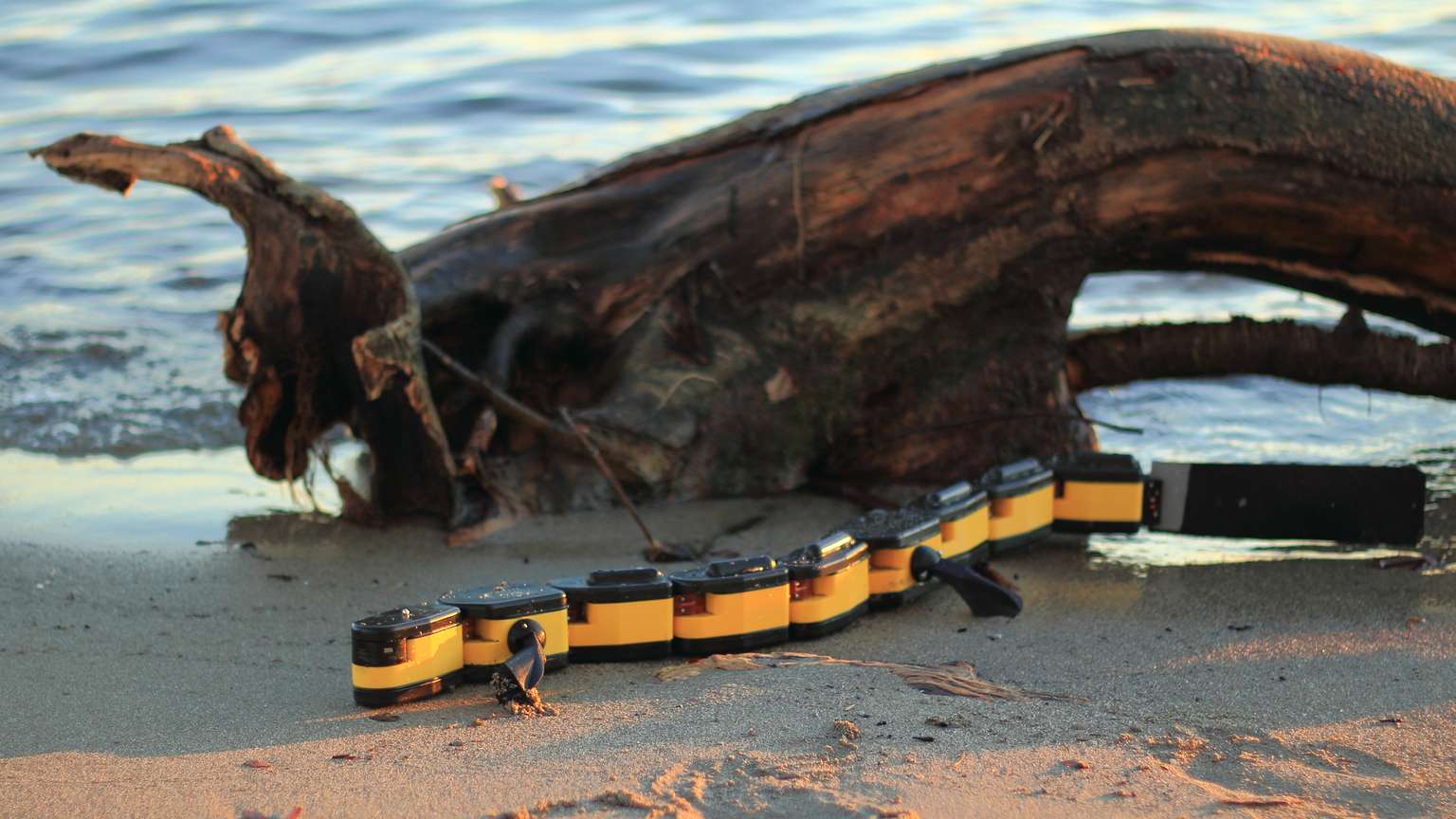
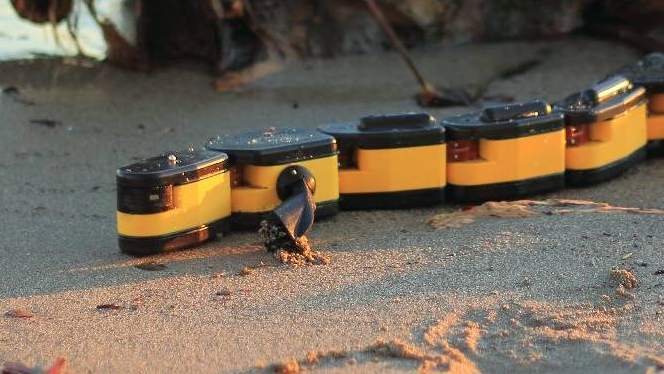
This page describes our latest model of the salamander locomotor circuit and its implementation in our new salamander-like robot: Salamandra robotica. This work appears in Science's March 9 2007 issue. It extends previous work we did on salamander locomotion using neuromechanical simulations. Using the salamander as an animal model, we address three fundamental issues related to vertebrate locomotion: (i) the modifications undergone by the spinal locomotor circuits during the evolutionary transition from aquatic to terrestrial locomotion, (ii) the mechanisms necessary for coordination of limb and axial movements, and (iii) the mechanisms that underlie gait transitions induced by simple electrical stimulation of the brain stem. We address these questions with the help of a numerical model of the salamander's spinal cord that we implement and test on a novel salamander-like robot capable of swimming and walking. Consequently, this study is also a demonstration of how robots can be used to test biological models, and in return, how biology can help designing robot locomotion controllers. The model simulates the central pattern generator (CPG, i.e. a circuit capable of producing coordinated patterns of rhythmic neural activity) underlying locomotion in the spinal cord. It is implemented as a system of coupled nonlinear oscillators and runs on a microcontroller on board of the amphibious robot. To the best of our knowledge it is the first robot that combines the three modes of locomotion --swimming, serpentine crawling and walking-- in a single robot. Simple drive signals are sent wirelessly from a laptop to the robot to modulate locomotion, similarly to how upper centers in the brain send simple signals to the spinal cord for initiating and modulating locomotion. The purpose of the robot is three-fold: (i) to show that our CPG model can generate forward motion with variable speed and heading (i.e., aspects that need a "body" for validation and cannot be studied at a neuronal level alone), (ii) to qualitatively compare the gaits generated to those of the real salamander, and (iii) to show that the concept of CPGs can lead to robust locomotion control for robots with multiple articulated joints. Our work demonstrates that the spinal cords contains rather sophisticated neural circuits that can control complex locomotion while receiving only high-level command signals. In particular, we demonstrate how a primitive neural circuit for swimming like the one found in the lamprey can be extended by phylogenetically more recent limb oscillatory centers to explain the ability of salamanders to switch between swimming and walking. Our work also suggests a mechanism that explains how gait transition between swimming and walking can be obtained by simply varying the level of stimulation of the brain stem. The mechanism is based on two hypotheses: (1) that limb oscillatory centers are slower than body oscillatory centers, and (2) that limb oscillatory centers saturate (i.e. stop oscillating) when receiving a high level of drive. The first hypothesis had been confirmed with new biological experiments (see the Sup. Mat. on the Science website). This type of automatic gait transition induced by simple electrical stimulation has been observed in many vertebrates but is yet poorly understood. Additionally our model explains how the coordination between body and limbs is maintained during locomotion. Finally, the model also gives a potential explanation of how salamanders control their speed and direction of locomotion, by respectively modulating the level and the asymmetry of drive applied to the spinal cord. People involved: Auke Ijspeert, Alessandro Crespi, André Guignard, André Badertscher, Jean-Marie Cabelguen (Univ. of Bordeaux), Dimitri Ryczko (Univ. of Bordeaux 2). Image and Video use
Images and videos on this web page can be used without prior
permission, provided they are credited as follows: Figures in the article (from the preprint)Also in eps format: fig1a.eps fig1b.eps fig2.eps fig3ab.eps fig3c.eps fig4ab.eps fig4c.eps Sample animations/movies
The AVI files require the DivX codec see http://www.divx.com or the Xvid codec see http://www.xvid.org.
Low resolution pictures (click on the thumbnails)High resolution pictures (between 4.0 and 15.0 MB, same order as above)a_herzog_lake8.jpg, a_herzog_lake1.jpg, a_herzog_lake2.jpg, a_herzog_lake3.jpg, a_herzog_lake4.jpg, a_herzog_lake5.jpg, a_herzog_lake6.jpg, a_herzog_lake7.jpg, a_herzog_lake9.jpg, a_herzog_outside1.jpg, a_herzog_outside2.jpg, a_herzog_outside3.jpg, a_herzog_lab1.jpg, a_herzog_lab2.jpg, a_herzog_lab3.jpg Related publicationsA.J. Ijspeert, A. Crespi, D. Ryczko, and J.M. Cabelguen. From swimming to walking with a salamander robot driven by a spinal cord model. Science, 9 March 2007, Vol. 315. no. 5817, pp. 1416 - 1420, 2007. Preprint.pdf, Supporting_online_material.pdf, Movie S1 (Quicktime, 4.3MB), Movie S2(Quicktime, 37.1MB)
A.J. Ijspeert, A. Crespi, and J.M. Cabelguen.
Simulation and robotics studies of salamander locomotion. Applying
neurobiological principles to the control of locomotion in robots.
Neuroinformatics, 3(3):171-196, 2005.
A.J. Ijspeert.
A connectionist central pattern generator for the aquatic and
terrestrial gaits of a simulated salamander.
Biological Cybernetics, 84(5):331-348, 2001. |
|
|
Site map © 2009 EPFL , 1015 Lausanne, tel. 021 693 26 58 |
||